
If you’re searching for clear, practical insight into the latest ai breakthroughs, emerging tech concepts, and smarter ways to optimize your devices and networks, you’re in the right place. The pace of innovation is relentless—new architectures, smarter systems, and performance hacks appear almost daily—making it difficult to separate meaningful progress from marketing noise.
This article is designed to cut through that clutter. We break down what’s actually changing in AI, smart devices, and network design, explain why it matters, and highlight how these advancements can improve efficiency, scalability, and real-world performance.
To ensure accuracy and relevance, we draw on peer-reviewed research, industry reports, and insights from engineers and technology analysts who work directly with next-generation systems. The result is a focused, trustworthy overview that helps you understand not just what’s new—but what’s useful.
By the end, you’ll have a clear view of the trends shaping modern tech and how to apply them strategically.
Artificial intelligence has shifted from a steady march to a sprint, and separating signal from noise is harder than ever. On one side, generative models now draft reports and design products; on the other, traditional software still follows rigid rules. Meanwhile, physical robotics is moving from lab demos to warehouse floors, whereas older automation stayed bolted in place. The real ai breakthroughs blend efficiency gains with scientific discovery, cutting energy costs while accelerating drug research. Skeptics argue it’s hype, yet side-by-side results show faster iteration, lower costs, and smarter networks. So, what’s next? Expect tighter human-AI collaboration, not replacement everywhere.
Beyond Text and Images: The Rise of Multimodal Generative AI
Not long ago, AI systems could only handle one type of input at a time. Early language models processed text. Image models generated pictures. Speech tools transcribed audio. Each system lived in its own lane. Today, that wall is coming down.
Multimodal generative AI refers to systems that can understand and produce multiple types of data—text, images, audio, video, and code—from a single prompt. In practical terms, you can describe a scene, generate a video, add a voiceover, and translate it instantly. That shift from single-modality to integrated capability marks one of the biggest ai breakthroughs in recent years.
For example, AI-powered video tools can turn a short script into a cinematic clip for marketing campaigns. Real-time voice cloning enables live translation during global meetings, preserving tone and emotion. Meanwhile, advanced code generation systems build full-stack applications from plain-language instructions, accelerating software prototyping.
However, some critics argue multimodal systems increase misinformation risks, especially with realistic video and voice synthesis. That concern is valid. Yet with watermarking, authentication protocols, and responsible deployment, the benefits often outweigh the downsides (much like how Photoshop didn’t end photography—it reshaped it).
As a result, industries are evolving fast. Designers iterate visually and verbally. Developers debug through conversation. Accessibility tools now convert speech to text to visuals seamlessly, helping users with diverse needs.
Ultimately, this integration lays the groundwork for smart devices that can see, hear, and respond naturally—bringing human-computer interaction closer to everyday conversation.
From Code to Concrete: AI’s Impact on Robotics and the Physical World
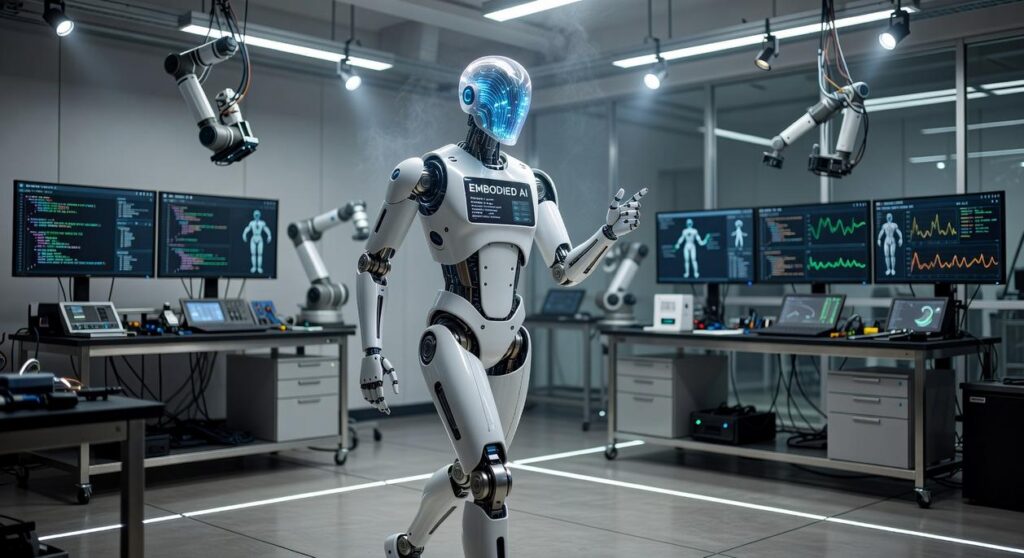
Embodied AI refers to artificial intelligence systems that can perceive, reason, and act in the physical world using sensors, actuators, and robotic hardware. In simple terms, it’s AI with a body. Cameras function as eyes, force sensors act like touch, and motors execute decisions. Instead of just generating text or images, embodied systems stack boxes, inspect bridges, or navigate busy sidewalks.
Many assume recent ai breakthroughs in robotics are purely about bigger models. That’s only half true. More importantly, reinforcement learning—where machines learn through trial and error guided by rewards—has matured. Think of it like training a dog, except the “treat” is a mathematical signal. Coupled with simulation-to-real transfer (training robots in virtual environments before deploying them physically), machines now learn tasks like warehouse sorting or precision assembly faster and with fewer costly mistakes.
However, not everyone is convinced. Critics argue robots remain brittle outside controlled environments. Fair point. Yet autonomous drones now inspect power lines in shifting winds, and early general-purpose humanoids can handle multi-step tasks. That’s progress you can’t dismiss (even if we’re still far from The Jetsons).
Under the hood, specialized network architectures process real-time sensory streams with minimal latency. These systems prioritize fast inference—decision-making speed—over sheer model size.
Pro tip: In robotics, milliseconds matter more than model bragging rights. When AI moves from code to concrete, timing is everything.
Smaller, Faster, Smarter: The Push for Efficient AI Models
“Do we really need a model with a trillion parameters just to autocomplete an email?” a senior engineer asked during a recent AI panel. The room laughed—but the question stuck.
The Efficiency Problem
Today’s largest AI systems consume enormous computing power and electricity. Training GPT-3, for example, reportedly used hundreds of megawatt-hours of energy (MIT Technology Review). That scale limits who can compete and drives up costs. Critics argue that bigger models deliver better accuracy—and they’re often right. But performance gains are shrinking while energy bills keep climbing (the law of diminishing returns, now with GPUs).
Optimization Hacks That Work
Instead of scaling up endlessly, researchers are refining models through:
- Quantization – reducing numerical precision to make models lighter and faster.
- Pruning – cutting unnecessary parameters without sacrificing performance.
- Knowledge distillation – training smaller models to mimic larger ones.
“Think of it as teaching a junior analyst everything the senior knows—without the overhead,” one data scientist explained.
These techniques are fueling ai breakthroughs that prioritize efficiency over brute force.
The Rise of Edge AI
Running AI directly on smartphones and IoT sensors—called Edge AI—means faster responses, better privacy, and less cloud dependence. Your phone recognizing speech offline? That’s edge computing in action.
For businesses tracking quantum computing milestones what they mean for businesses, efficiency trends matter just as much as raw power.
The result: smarter devices that work instantly—even in airplane mode (finally).
Accelerating discovery once meant slow, linear progress: hypothesis, experiment, revision. Today, AI reshapes that sequence. In simple terms, artificial intelligence—systems that learn patterns from data—acts as a cognitive amplifier. Instead of scanning thousands of research papers manually, scientists deploy models that analyze millions of data points in hours.
Consider protein folding. Traditionally, mapping a protein’s 3D structure took years of lab work. By contrast, AI-driven systems predict structures in days, accelerating drug discovery. Similarly, materials science once relied on trial-and-error synthesis; now algorithms design compounds with specific conductivity or strength before a single sample is produced.
Critics argue machines can’t replace human intuition. Fair point. Yet this isn’t AI versus scientists; it’s AI plus scientists. Climate modeling, for example, becomes more precise when machine learning processes satellite data alongside expert judgment.
In other words, ai breakthroughs are not shortcuts—they’re force multipliers, compressing decades of iteration into months. Adopt AI early.
Multimodal generation, embodied robotics, leaner models, and scientific acceleration define this era of ai breakthroughs. Systems now see, speak, move, and simulate molecules with startling fluency.
Common wisdom says AI is still “just software.” I disagree. It’s rapidly becoming infrastructure—embedded in chips, factories, hospitals, and homes.
When robots learn by watching video and drug candidates are generated in silico, the boundary between digital and physical dissolves. (Your phone is basically a lab assistant now.)
The real shift isn’t smarter chatbots; it’s machines reshaping matter, medicine, and mobility.
Understanding these vectors isn’t optional. It’s survival for the next decade of innovation.
Stay Ahead of the Next Tech Shift
You came here to understand how emerging tech trends, smart device advancements, and ai breakthroughs are reshaping the digital landscape—and now you have a clearer, actionable picture of what’s happening and why it matters.
The pace of innovation isn’t slowing down. Networks are getting smarter. Devices are becoming more autonomous. Optimization is no longer optional—it’s the edge. If you ignore these shifts, you risk falling behind competitors who are already adapting and automating.
Now is the time to act. Start implementing the optimization hacks outlined above. Audit your current tech stack. Integrate forward-thinking architecture strategies. Track ai breakthroughs closely and align them with your growth roadmap.
If staying competitive, efficient, and future-ready is your goal, don’t wait. Plug into real-time innovation alerts, apply these insights immediately, and position yourself ahead of the curve. The next wave of tech transformation is already here—make sure you’re leading it, not reacting to it.