

If you’re researching software-defined networking, you’re likely looking for clarity—what it is, why it matters, and whether it’s worth implementing in your environment. With networks becoming more complex, distributed, and performance-driven, traditional architectures can’t always keep up. This article is designed to break down exactly how software-defined networking works, where it delivers the most value, and which software defined networking benefits have the biggest real-world impact.
We’ll examine how centralized control improves visibility, how automation reduces configuration errors, and how programmable infrastructure accelerates deployment across cloud, edge, and hybrid environments. You’ll also gain practical insight into scalability, cost efficiency, and security enhancements—without the jargon that often clouds technical discussions.
Our analysis is grounded in current network architecture research, enterprise deployment case studies, and emerging infrastructure trends, ensuring you get accurate, up-to-date guidance you can confidently apply to modern IT environments.
Unlocking Network Potential: Why Software-Defined Architecture is the Future
Traditional networks bundle the control plane (the brain that decides where traffic goes) with the data plane (the muscle that moves it). That tight coupling makes every change slow and expensive.
Software-Defined Networking (SDN) separates those layers. Think of it like upgrading from manual gear shifts to automatic—less friction, more precision.
Here’s what that means in practice:
- Centralized control instead of device-by-device configuration
- Faster deployment of apps and services
- Smarter traffic management
- Lower hardware dependency
These software defined networking benefits translate into simpler management, stronger security policies, and reduced operational costs.
Centralized Control: Simplifying Network Management from a Single Pane of Glass
I still remember the night I had to log into 47 separate switches to fix a misconfigured VLAN. Somewhere around device 23, coffee stopped helping. (If you’ve ever watched a progress bar crawl at 2 a.m., you know the feeling.)
That experience made decoupling click for me.
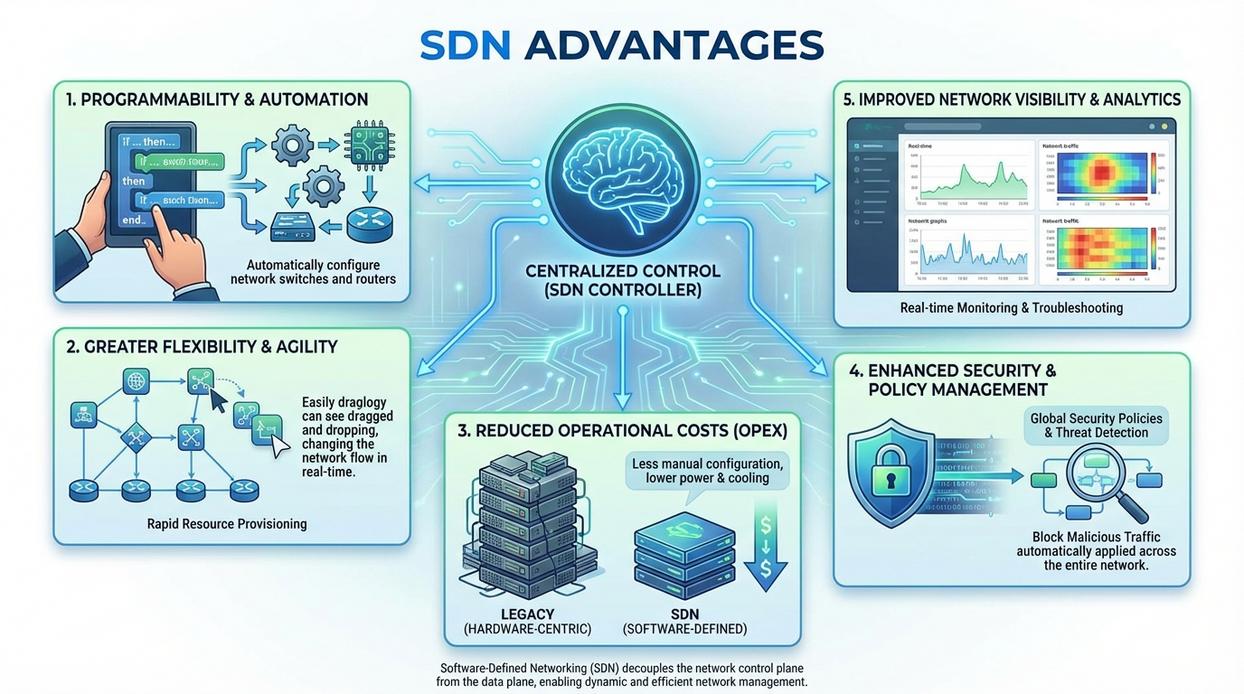
In Software-Defined Networking (SDN), decoupling means separating the control plane (the decision-making “brain”) from the data plane (the traffic-forwarding “muscle”). Traditionally, each device had both. With SDN, intelligence moves to a centralized controller, while switches simply follow instructions.
The result? A single pane of glass view of the entire network. Instead of guessing how devices interact, administrators see topology, policies, and traffic flows in one dashboard. It’s less “Where’s Waldo?” and more mission control.
Some engineers argue centralized control creates a single point of failure. Fair concern. But modern controllers are built with redundancy and clustering (think backup singers who never miss a cue). The operational clarity usually outweighs the risk.
Contrast this with device-by-device configuration. One typo in an ACL (Access Control List, which filters traffic) can cause outages—or worse, security gaps. Centralized policy enforcement drastically reduces human error and inconsistency.
In practice, admins push updates, configure rules, and troubleshoot globally—no more serial console marathons. That’s one of the key software defined networking benefits: saving time while improving accuracy.
Pro tip: Always simulate policy changes before deployment to avoid unintended ripple effects.
Unprecedented Agility and Automation for Rapid Service Delivery
Have you ever wondered why launching a new application can take weeks—even when the code is ready in days? The bottleneck is often the network.
Programmable infrastructure changes that equation. With Software-Defined Networking (SDN), the control layer of the network is abstracted and exposed through APIs (Application Programming Interfaces—software bridges that let systems talk to each other). Instead of manually configuring routers and switches, developers and IT teams can program the network like they would any other application.
What does that mean in practice?
- Automated provisioning of virtual networks, bandwidth, and security policies in minutes
Through automation, routine tasks—like configuring VLANs, assigning IP ranges, or applying Quality of Service (QoS, which prioritizes critical traffic)—happen instantly. No tickets. No back-and-forth emails. Just policy-driven execution.
Imagine deploying a new customer-facing app. The moment it spins up, it automatically requests the bandwidth it needs, applies predefined security rules, and segments traffic appropriately. The network responds in real time. Deployment times shrink from weeks to minutes. Sound familiar to the kind of speed your competitors are chasing?
Skeptics argue automation adds complexity. But in reality, standardized APIs reduce human error and increase consistency (and let’s be honest, manual configs at 2 a.m. rarely go perfectly).
The business impact is clear: faster service rollouts, quicker pivots when markets shift, and measurable software defined networking benefits that translate into competitive advantage.
Fortifying Security with Granular Policy Enforcement and Micro-Segmentation
In today’s threat landscape, speed matters. With a centralized SDN controller, suspicious behavior can be detected and isolated in seconds, not hours. So instead of chasing alerts across disconnected systems, teams can automatically reroute traffic or block compromised devices before damage spreads. That’s one of the core software defined networking benefits: real-time, network-wide threat response.
Equally important is micro-segmentation, a strategy that divides the network into tightly controlled zones. If an attacker slips in, their movement is restricted to a small segment instead of the entire environment. In practice, that means a compromised IoT camera can’t suddenly access payroll databases (yes, that’s happened). SDN simplifies creating and adjusting these zones, turning what used to be weeks of manual configuration into a policy-driven task completed in minutes.
Moreover, policies are defined once and enforced consistently across wired, wireless, and virtual environments. This consistency closes the security gaps that attackers often exploit in complex, manually configured networks. For organizations seeking measurable risk reduction, aligning with best practices for secure network segmentation ensures every segment follows the same rules without exception. Ultimately, you gain visibility, control, and confidence in every connection. That’s security done right.
Reducing costs in modern networks starts with clarity about where money actually goes. First, lowering Operational Expenditure (OpEx) means cutting the hours spent on repetitive configuration and troubleshooting. Automation and centralized control let teams push updates across hundreds of devices in minutes instead of days. That frees engineers to focus on security audits or cloud strategy rather than manual patchwork (which no one enjoys).
Next, optimizing Capital Expenditure (CapEx) relies on intelligent traffic engineering. Data is routed along the most efficient path, maximizing existing bandwidth and delaying expensive hardware upgrades. For example, a retail chain can handle seasonal spikes without immediately buying new switches.
Additionally, vendor independence matters. By supporting commodity white-box hardware, organizations avoid lock-in and negotiate better pricing. In practice, these software defined networking benefits translate into leaner budgets and smarter growth. Pro tip: audit bandwidth utilization quarterly to spot waste before it becomes a purchase order request.
Step into a modern network operations room and you can almost hear the HUM of possibility. Dashboards glow, alerts pulse softly, and control feels centralized instead of chaotic. That shift is the promise of SDN. By replacing rigid, hardware-bound systems, it untangles bottlenecks and lets traffic flow like a well-conducted orchestra. Skeptics argue legacy setups are “good enough.” But good enough rarely scales. The software defined networking benefits—automation, visibility, tighter security—translate into faster fixes and lower costs. Evaluate your infrastructure with fresh eyes, and you’ll sense where agility could unlock smarter, more responsive performance. Right now, choose flexibility over friction.
Build a Smarter, Faster Network Today
You came here to understand how modern network architecture and intelligent optimization can transform your infrastructure. Now you have a clearer view of how emerging Pax tech concepts, automation, and software defined networking benefits work together to eliminate bottlenecks, improve scalability, and reduce operational drag.
The real pain point isn’t just outdated hardware — it’s lost speed, rising costs, security blind spots, and missed innovation opportunities. Falling behind in network evolution means slower deployments, reactive troubleshooting, and constant firefighting instead of strategic growth.
Act on what you’ve learned. Start auditing your current network architecture, identify inefficiencies, and implement smarter segmentation and automation strategies. Tap into cutting-edge innovation alerts and optimization hacks to stay ahead of performance demands.
If you’re ready to eliminate complexity and future-proof your infrastructure, explore the latest tech insights and network optimization strategies now. Join thousands of forward-thinking professionals already leveraging smarter systems to stay competitive. Don’t wait for downtime to force change — upgrade your network strategy today.